
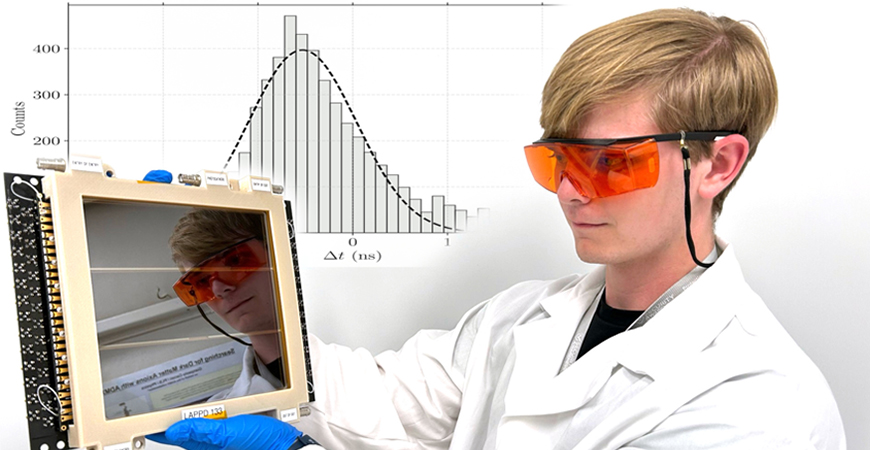
Detecting neutrinos and other elusive subatomic particles often relies on capturing tiny flashes of light produced when these particles interact with specialized detection media. In water-based scintillators, there is a competition between Cherenkov light (which is faint but directional and prompt) and scintillation light (which is strong but uniformly emitted and delayed). Discriminating between these two types of light requires sensors and electronics that are both extremely fast and highly accurate.
To meet this challenge, a research team at Lawrence Livermore National Laboratory (LLNL), in collaboration with students from the University of California (UC), Merced, through the National Nuclear Security Administration’s (NNSA’s) Minority Serving Institutions Internship Program (MSIIP), have successfully characterized a new photosensor and advanced electronics system that could transform how scientists detect subatomic particles. The technology also holds promise for applications in medical imaging and radiation monitoring, where fast and accurate detection of light is critical.
At the heart of this development is the second-generation Large Area Picosecond Photodetector (LAPPD), described in a paper published in Review of Scientific Instruments. Though not originally developed at Livermore, LLNL researchers have worked to test and characterize the technology, demonstrating that this device can track the trajectory of individual photons — particles of light — with extraordinary precision across a wide area. These capabilities are essential for experiments that require both precise timing and spatial information, such as large-scale neutrino detectors that use innovative water-based liquid scintillators, which are also part of this project under the NNSA’s Office of Defense Nuclear Nonproliferation.
The team paired the new LAPPD with state-of-the-art system-on-chip (SoC) electronics from the software company Nalu Scientific, including the high-density SoC and the advanced SoC rapid digitizer variable adaptive readout chip.
The setup allows for the detailed characterization of crosstalk, meaning how signals from one pixel interfere with others. The team also identified and measured subtle timing differences between pixels (called timing jitters), demonstrating the system’s ability to resolve even the smallest delays. These results validate the system’s potential for future neutrino experiments and other scientific applications, marking the first successful integration and demonstration of these technologies together.
“Working at LLNL this past summer was an opportunity like none other. It was a lot of fun to work on the LAPPD/SoC study, as there were always new questions popping up in our investigation that challenged our previous conception of the system’s physical behavior,” said Shang-Wen Stradleigh, a 2025 undergraduate summer intern from UC Merced.
“Perhaps the most memorable moment was the discovery that the two-pixel delay timing jitter had a direct dependence on the incoming photoelectron intensity level, as we kept doubting the results until repetitive measurements on multiple optical setup variations helped confirm our observations. I hope to continue my research in the field of neutrinos and work on novel optical setups, as this experience has taught me that there is plenty more to be done,” Stradleigh added.
In addition to Stradleigh, other UC Merced-MSIIP students involved in the project include 2024 summer intern and current graduate student James Foot and 2025 undergraduate intern Edward Zhang, who was not part of the initial study but is now pursuing follow-on research with the LAPPD.
“Our interns do far more than assist; they take ownership of complex measurements,” said LLNL scientist Viacheslav (Slava) Li. “Beyond our findings, which are informing the next generation of photosensors with system-on-chip instrumentation, observing the next generation of researchers grow is even more fulfilling.”
[V.A. Li, O. A. Akindele, M. Bondin, S.R. Durham, J.A. Foot, M.J. Ford, S.-W. Stradleigh, Initial assessment of second generation of large-area picosecond photodetectors with multi-channel systems-on-a-chip readout, Review of Scientific Instruments (2025), doi: 10.1063/5.0269181.]
